
Since opening its doors in 1975, Upper Valley Career Center Adult Education has provided career-focused training to meet the needs of adult learners while addressing regional workforce needs. Located in Piqua, just 30 minutes north of Dayton, the center serves as an Ohio Technical Center under the Ohio Department of Higher Education, delivering industry-aligned credentials in healthcare, skilled trades, technical fields, and adult diploma programs.
In recent years, UVCC has strategically aligned its secondary career technical programs with adult education offerings, focusing on high-demand healthcare and industrial fields. The goal is to create seamless, accelerated pathways that reduce barriers for students and strengthen the regional workforce.
“The long-term vision is to create a pathway for students to continue their career tech education,” said Duane Caudill, Director of Adult Education at Upper Valley Career Center. “Students may complete a high school program, and our programs allow them to continue and expand their learning.”
This idea started taking shape in 2020, when administrators looked closely at how secondary and adult programs intersected. “We looked at where the overlaps are, where we are different, where we are the same,” Caudill explained. “We started to see some really good opportunities in extending that pathway upward.”
In the healthcare programs, that alignment is already producing measurable results. Students in UVCC’s high school Medical Careers Academy can earn their Certified Nursing Assistant (CNA) credential before graduation. Through coordinated advising and screening, eligible seniors can transition directly into the Adult Education Practical Nursing program.
One recent success story illustrates the impact. A student began the Practical Nursing program in fall 2024 while finishing her senior year of high school. She graduated in spring 2025 and completed the nursing program that fall, finishing roughly eight months ahead of a traditional timeline. She has since passed the NCLEX exam and is now working in the field as a licensed practical nurse.
“It really did put her about eight months ahead of where she would have been,” Caudill said.
Interest in the program continues to grow, with additional students already enrolled or preparing to enter. This model also reduces common transition barriers: students who move directly from high school to adult education are already familiar with the campus, equipment, and expectations.
UVCC’s recent $18 million, 57,000-square-foot campus expansion, completed in November 2025, has further strengthened this approach. Both the high school Medical Careers Academy and adult healthcare programs now share a dedicated wing. On the adult education side, the expansion includes a 10-bed skills lab, a dedicated CNA training space, and expanded classrooms. On the high school side, it includes two new labs: one for medical office and physician training, and another for hospital and long-term care experiences. All secondary and postsecondary programs now share access to the new state-of-the-art simulation labs.
“Having those shared spaces and being able to work more closely with the high school students has really been beneficial,” Caudill said. “They can see that there is a pathway there that makes sense for them.”
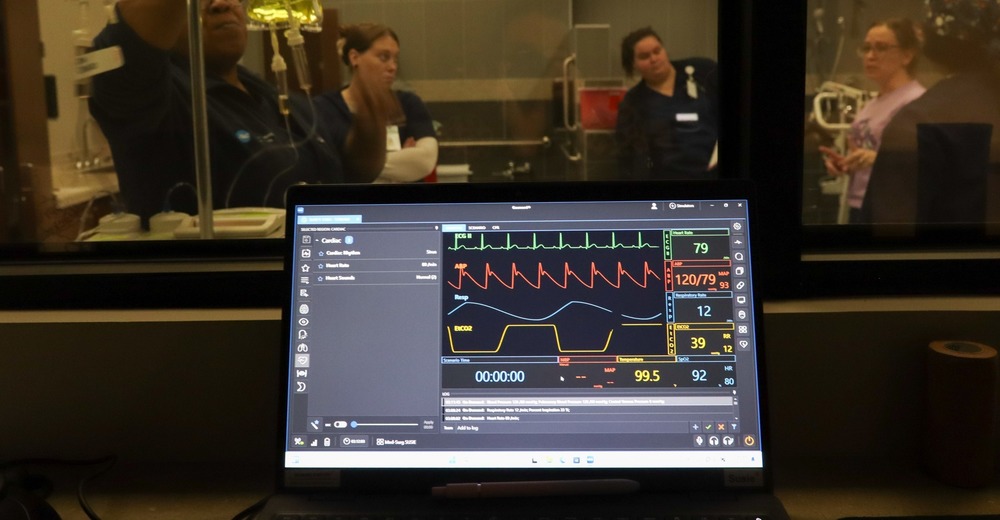
These simulation labs bring real-world experiences right to campus. One room focuses on labor, delivery, and pediatrics, complete with a mannequin capable of simulating childbirth, while another mirrors a hospital critical care or long-term care setting, including a full shower and bath area. Between the two, a one-way observation room allows instructors to monitor students and adjust scenarios in real time. As students practice responding to vital signs and patient needs without an instructor in the room, Caudill said, “Really it just mirrors a more real-world scenario for these students.”
According to data from the ACCSC Annual Reports for 2024 and 2025, UVCC Adult Education’s nursing programs have averaged an 81% completion rate across the Practical Nursing and LPN-to-RN programs, with graduates achieving an average employment rate of 78.5%.
With the additional capacity, UVCC now operates two cohorts per year for both the Practical Nursing and LPN-to-RN diploma programs, training up to 100 nurses annually. The shared environment not only increases capacity but also shows high school students the next steps in their education.
Further investment will continue this summer with renovations to the Adult Technology Center, which opened in 1992 as a dedicated space for adult education programming. The project will modernize industrial labs, enhance classrooms for the adult diploma program, and introduce updated student common areas designed to support collaboration and continued growth.
“OTCs are growing across the state, and Upper Valley is seeing that growth as well,” Caudill said. “We are pleased with the direction everything is moving and the ability to offer better training for the community.”
By intentionally aligning secondary and adult programming, Upper Valley Career Center demonstrates how career technical education systems can work together to expand student opportunity, accelerate credential attainment, and address Ohio’s workforce needs.